The Meditative Joy of Cleaning a Community Kitchen

For three-out-of-four of my years at Carleton College I have lived in Farm House– an exquisitely lovely “interest house” centered around food, farming, sustainability, and community living. The house has been a central feature of my college experience. It has helped me keep busy and social, and many of my fondest college memories occurred within the houses walls or in its expansive yard.

The house is loosely associated with the student farm, which is located just outside our door. (The farm is managed by a farming club and two or three student workers over the summer, but there is often overlap between the farmers and the residents.) We divvy up household chores, take turns cooking, eat communal dinners, and put on events for the campus.

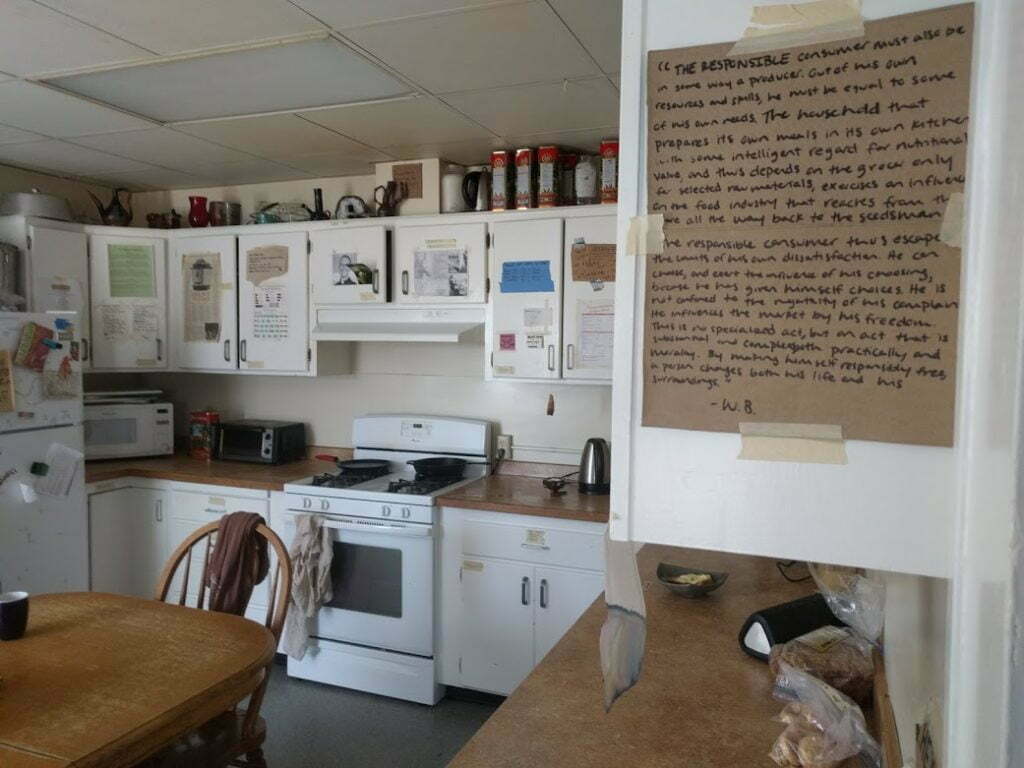
It occurs to me that I have devoted a great deal of time to cooking in, and cleaning up, this house’s kitchen, a task that is absent the lives of many of my peers who opt to remain on the meal plan all four years. Some say “I’ll have to cook and clean for the rest of my life, I want to enjoy the dining halls while they are here.” And I understand that sentiment. But I have found the cooking to be quite manageable when we share the responsibility, and cleaning the Farm House kitchen often feels less like a chore and more like a soothing respite from the bustle and stress of college– a kind of meditative joy. Continue reading “The Meditative Joy of Cleaning a Community Kitchen” →

Make New Humans (A Meiosis Song)

For my genetics class, we were tasked with reviewing meiosis and then producing evidence of our review. To that end, I give you: “Make New Humans (A Meiosis Song).”

Lyrics:

Double-stranded DNA
Gets undone by helicase
But you don’t really care about interphase, now do you?
The subject here is meiosis
The first prophase the cytokinesis
The process by which we make new humans

Make new humans [x4]

Well mitosis works pretty well
For cloning autosomal cells
But if you want real evolution, baby, it just won’t do you.
But imagine if during anaphase
Cohesin kept the chromatids in place,
So homologous chromosomes were the ones split by microtubules

Microtubules [x4]

Now when you’re making up haploid cells
Independent assortment is swell
If you wanna guarantee your progeny don’t look just like you
But why not pick up even more variation?
Through interchromosomal recombination
“Crossing over” helps us make new humans

Make new humans [x4]

[For lyrics with chords, click here].

Dear Bernie

Dear Bernie,

It looks like the race to become the Democratic nominee is coming to a close. Whatever happens next, I want to thank you– both for the incredible presidential campaign you have run, and for the prior 30+ years you spent in public service. As I have educated myself about your political career, I have been profoundly inspired by your empathy, foresight, integrity, and drive.

I watched with awe and admiration how you passionately argued for military spending cuts before the House of Representatives in 1992:

We are spending $270 billion a year on the military, but we don’t have a major enemy! I know it hurts your feelings, I know you’re upset about it, I know you’re hoping and praying that maybe we’ll have another war, maybe somebody will rise up. But it ain’t happening! … Let’s have the guts to give leadership to this country. The Cold War’s over. Let’s reinvest in America.

Perhaps a dozen times I watched the clip of you rising in opposition to the 1991 crime bill to declare:

This is not a crime prevention bill. This is a punishment bill, a retribution bill, a vengeance bill… If you wanna get tough on crime, let’s deal with the causes of crime. Let’s demand that every man, woman, and child in this country have a decent opportunity and a decent standard of living, let’s not keep putting poor people in jail and disproportionately punishing blacks.”

And I wept as I watched you, realizing how uncommon this view was at the time, and knowing that those crime bills of the early 1990s did not make crime drop but instead helped construct today’s system of racially-biased mass incarceration.

You were right right about the crime bill, Bernie– they were wrong. Just as you were right to oppose war in Iraq. Just as you were right to repeatedly oppose the Patriot Act and the mass surveillance it entailed. Just as you were right to gallantly filibuster the 2010 agreement that extended Bush-era tax cuts for millionaires and billionaires. Just as you were right to vote and speak out against ineffective “war on drugs” policies again and again and again. You have been right so many times over the years, Bernie, while the popular view has been painfully, dangerously, destructively, wrong. Why couldn’t more people see that?

Continue reading “Dear Bernie” →

In Defense of Divestment

What is fossil fuel divestment?

It is an international network of campaigns calling on powerful institutions to sell any stocks/bonds they hold in the top 200 fossil fuel companies. Many colleges, governments, and foundations have already divested: my own Carleton College has not.

Why might an institution want to divest?

ExMIt was recently unearthed that as early as 1977, ExxonMobil– the world’s largest oil and gas company– knew that their product was causing global temperature rise that could prove catastrophic. Rather than change their business model, they spent tens-of-millions of dollars propagating misinformation, obstructing political action, and cultivating denial across the globe.1

The other major players have all done the same: deny, distract, and drill baby drill.

While many of these companies have changed their tone, they have not changed their actions. “For well over a decade, several of the oil majors have claimed to be voluntarily using their profits to invest in a shift to renewable energy,” writes Naomi Klein in This Changes Everything, “but according to a study by the Center for American Progress, just 4 percent of the Big Five’s $100 billion in combined profits in 2008 went to ‘renewable and alternative energy ventures.’”2 The rest went to shareholders, uber-rich executives, climate denial lobby groups, and the pursuit of ever-more-elusive oil, gas, and coal.

For decades, fossil fuel companies have unequivocally failed to recognize and respond to the threat their business creates. Moreover, they have deliberately suppressed localized and renewable energy models3 and disproportionately targeted communities of poor people and people-of-color as the sites of pollution-generating wells, refineries, and pipelines.4

To divest is to acknowledge the myriad offenses of fossil fuel companies and emphatically declare “We can no longer, in good conscious, make the profits of fossil fuel companies our own.” It’s a powerful symbolic gesture gaining traction across the world. But it is often misunderstood.

Continue reading “In Defense of Divestment” →