The Meditative Joy of Cleaning a Community Kitchen

For three-out-of-four of my years at Carleton College I have lived in Farm House– an exquisitely lovely “interest house” centered around food, farming, sustainability, and community living. The house has been a central feature of my college experience. It has helped me keep busy and social, and many of my fondest college memories occurred within the houses walls or in its expansive yard.

The house is loosely associated with the student farm, which is located just outside our door. (The farm is managed by a farming club and two or three student workers over the summer, but there is often overlap between the farmers and the residents.) We divvy up household chores, take turns cooking, eat communal dinners, and put on events for the campus.

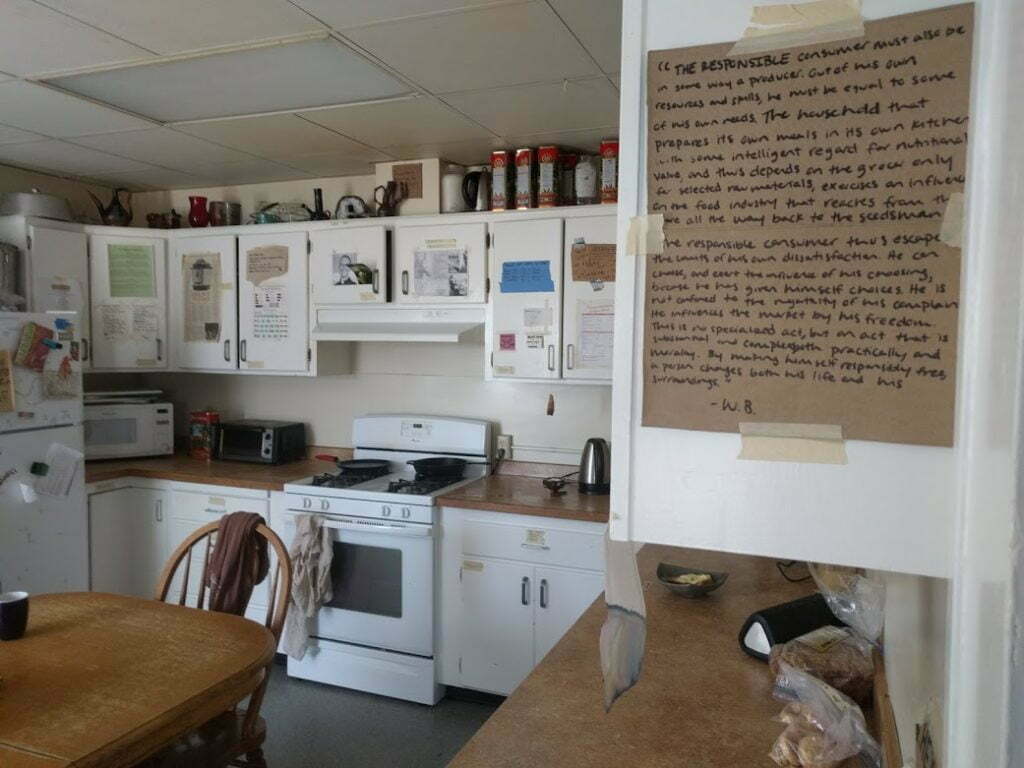
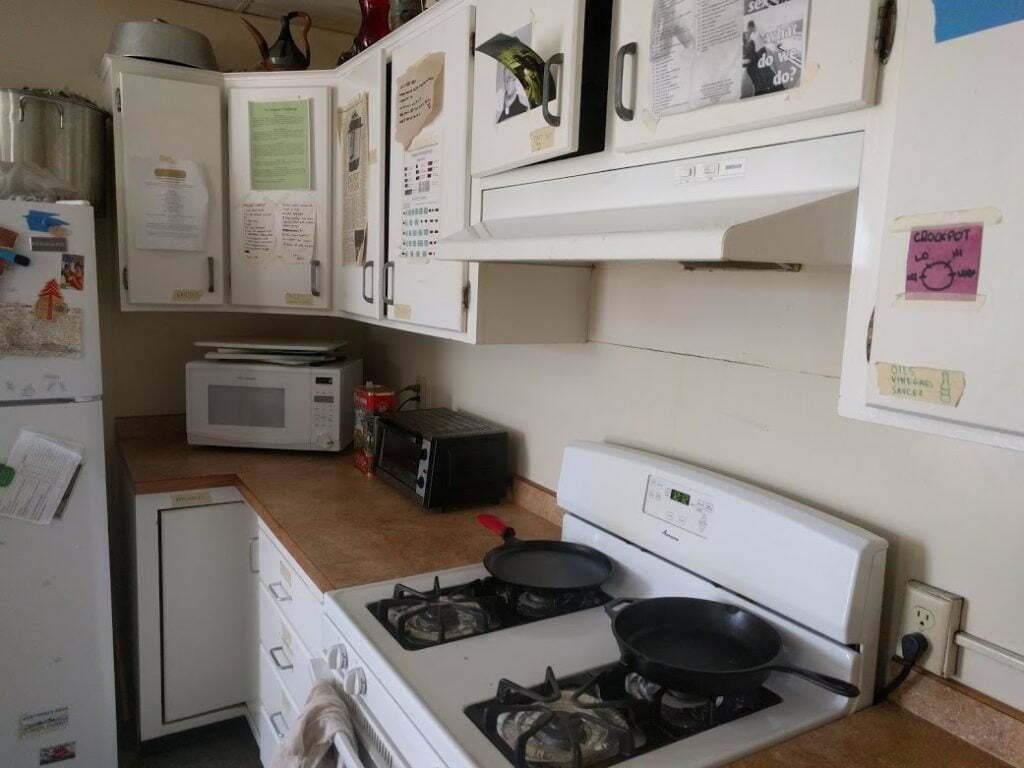
It occurs to me that I have devoted a great deal of time to cooking in, and cleaning up, this house’s kitchen, a task that is absent the lives of many of my peers who opt to remain on the meal plan all four years. Some say “I’ll have to cook and clean for the rest of my life, I want to enjoy the dining halls while they are here.” And I understand that sentiment. But I have found the cooking to be quite manageable when we share the responsibility, and cleaning the Farm House kitchen often feels less like a chore and more like a soothing respite from the bustle and stress of college– a kind of meditative joy. Continue reading “The Meditative Joy of Cleaning a Community Kitchen” →

On Dylan’s “Mama You Been On My Mind”

Mama You Been On My Mind

See lyrics

Perhaps it’s the color of the sun cut flat and coverin’
The crossroads I’m standin’ at.
Or maybe it’s the weather or somethin’ like that.
But, mama, you been on my mind.

I don’t mean trouble please don’t put me down or get upset.
I am not pleading or saying I can’t forget you.
I do not pace the floor bowed down and bent but yet,
Mama you been on my mind.

Even though my eyes are hazy and my thoughts they might be narrow
Where you been don’t bother me or bring me down with sorrow.
I don’t even mind who’ll you be waking with tomorrow.
Mama, you’re just on my mind.

I’m not askin’ you to say words like yes or no.
Please, understand me.
I have no place I’m callin’ you to go.
I’m just whispering to myself so I can’t pretend that I don’t know.
Mama, you been on my mind.

When you wake up in the mornin’ baby look inside your mirror.
You know I won’t be next to you. You know I won’t be near.
I’d just be curious to know if you can see yourself as clear
As someone who has had you on his mind.

This is one of my all-time favorite Dylan songs. It provides a rich and moving glimpse into a relationship that is at a “crossroads”– forced to pivot into a new phase by some unnamed force. It’s a love song that is not cut from a clean template. It’s not about love sought or love achieved or love betrayed or any of those timeless motifs that abound across musical genres. It’s about something subtler and more complicated. It’s about a love that burns but does not consume; love required to exist in ambiguity.

To my mind, the song is doubly tender– tender in its show of affection, and tender in its show of restraint.

Dylan doesn’t say “I need you” or “you complete me” or “baby come back” or anything like that. Instead he sings “I’m not asking you to say words like yes or no, please understand me / I have no place I’m calling you to go … Mama, you’re just on my mind.” It’s a kind of half-hearted resignation. It’s both childish and mature, and ultimately just genuine. And beautiful and tragic.

It’s a song about love that should be acknowledged but not manifested for the time being. It’s about love that should be seen but not touched, like a painting. A song about love deferred. I have long been enchanted with the way the words fall together in every verse, and the honest, instantly intimate scene they create.

Notes on Forming a Bandana in College

Excerpts from my diary, on the process of forming a bandana in college:

January 14, 2015
I was in a bandana for a while back in high school, but then I graduated and I guess we just sort of went our separate ways. I imagined getting into a bandana again once I started college, but I’ve had trouble finding one that really suits me. None of the bandanas around here are really my style, ya know? Oh well.

February 8, 2015
A friend of mine pointed out that I don’t have to wait around until I stumble upon my dream bandana– I could form my own from scratch! I think this is a great idea. I already put an ad up on Craigslist, and made posters to hang on bulletin boards around campus:

College student looking for some dedicated, yet laid back fellas to help me form a bandana! I already own most of the necessary equipment… just need a few bandana mates willing to meet a couple times a week and make this thing happen. Call me!

Exciting stuff!

Continue reading “Notes on Forming a Bandana in College” →

The Insult and Absurdity of ‘Make America Great Again’

A "Make America great again" hat.

Of the many dangerous untruths espoused by the Trump campaign, perhaps none was so flagrant as the one embedded right in the campaign’s central promise, “Make America Great Again.” That phrase seemingly asks us to recall a period when the United States still offered freedom and prosperity to all– when the American Dream was alive and well, unmarred by today’s excesses of bad regulation, Washington elitism, and so-called “political correctness.” But when was that time? When was America great?1

  • Was America great in 1917, when President Wilson asked congress for a declaration of war against Germany, asserting “we are glad [to fight] … for the ultimate peace of the world and for the liberation of its peoples? 1917, when suffragist Alice Paul was being force-fed raw eggs through a tube in the psychopathic ward of the DC District Jail, for the grave offense of suggesting women should be allowed to vote?2
  • Was America great in 1962, when President Kennedy rallied support for the audacious national effort to land a man on the moon? 1962, when US troops plodded through puddles in Vietnam, burning the huts of the rural poor, and Americans were “faced with the cruel irony” Dr. King would later remark “of watching Negro and white boys on TV screens as they kill and die together for a nation that has been unable to seat them together in the same schools?”

The United States has harbored an abundance of great ideas, great individuals, and great moments. But they have always existed in tandem with profound and unconscionable violence, oppression, and anguish. Moreover, the freedoms and liberties of American life have always fallen disproportionately on the white, the male, the straight, and the wealthy, while the nation’s crimes and atrocities have always fallen disproportionately on the black and brown, the non-straight, the female-bodied, and the poor. For these reasons and more, we cannot nostalgically label as “great” any period of American history.

Continue reading “The Insult and Absurdity of ‘Make America Great Again’” →

Suggested Grammatical Conventions for Leftists, Progressives, and Radicals

Kurt Vonnegut Jr. once wrote “We are what we pretend to be, so we must be careful about what we pretend to be.” I would submit the corollary claim: “We mean what we say, so we must be very careful about what we say.” The way we use language reflects and informs how we think. Thus, I propose a few grammatical conventions to be adopted by those with leftist, progressive, and radical inclinations.

1. Refrain from capitalizing “american” and other nationalities.

The rise of Donald Trump, among other world events, suggests a resurgence of WWII-era nationalism; wasn’t “Make Germany Great Again” Hitler’s campaign slogan? It was no good then and it’s no good now! De-capitalize, de-emphasize, de-nationalize! Be proud of your country, but not too proud. Celebrate what’s good and criticize what’s bad. See yourself primarily as a citizen of the world, no more/less important than anyone else, and no more/less deserving of safety, dignity, freedom, and respect. (Eg. “My name is Dustin and I’m an american living on Earth.”) 

2. Exercise caution when using “we.”

“We” is a multifaceted pronoun that can be evoked (implicitly and explicitly) in a variety of forms. The collective we can be a powerful tool for generating feelings of solidarity and resilience within a community, and should be considered correct under the radical-grammatical framework (Eg. “We shall overcome” as a slogan of the american civil rights movement).

The national we, however, tends to impose a sanitized collective history and a simplistic collective will over a hugely diverse group of people, thereby erasing many individual’s narratives and needs. For example, in resigning from the 2016 Presidential race, Ted Cruz echoed a conventional claim, that “we were founded on… [the idea] that each of us have a right to find and use our god given gifts, a right to life, liberty and the pursuit of happiness.” In reality, of course, america’s founding slaveholders (to use Nathan Schneider’s term) made pallid efforts to extend such rights to most americans– namely those without property, white skin, a penis, or any combination thereof.3 Thus, this usage is not grammatically-radically correct and should be avoided. Continue reading “Suggested Grammatical Conventions for Leftists, Progressives, and Radicals” →

On “Permanent Revolution”

Karl Marx famously evoked the term “permanent revolution” in urging the disenfranchised working-class to rise up against their capital-owning oppressors. He was beseeching those suffering under the nascent system of industrial production to mount a sustained resistance against capitalist exploitation, and never settle for a compromise that made life slightly more tolerable but failed to alter the underlying power dynamic of their time.4

Things are different now– at least in much of the global north. The lines between ‘proletariat’ and ‘bourgeois’ are more ambiguous. Factory work has largely been replaced with service work and knowledge work. Many people now experience some degree of sovereignty and pleasure towards their jobs, even if they are not CEOs. Moreover, technological change has brought many comforts and securities to huge masses of people that were largely or entirely unattainable in the past.

Under these conditions, the notion of revolution may sound unpleasant and undesirable. The word might conjure up images of 18th century French revolutionaries beheading politicians, or Cuban revolutionaries ousting Batista through guerrilla warfare. Even poor Americans–living paycheck to paycheck, working multiple minimum wage jobs– are unlikely to desire that kind of revolution.

The fact is that revolution does not always need to be violent. But it does need to occur. Continually.

Continue reading “On “Permanent Revolution”” →

Dear Bernie

Dear Bernie,

It looks like the race to become the Democratic nominee is coming to a close. Whatever happens next, I want to thank you– both for the incredible presidential campaign you have run, and for the prior 30+ years you spent in public service. As I have educated myself about your political career, I have been profoundly inspired by your empathy, foresight, integrity, and drive.

I watched with awe and admiration how you passionately argued for military spending cuts before the House of Representatives in 1992:

We are spending $270 billion a year on the military, but we don’t have a major enemy! I know it hurts your feelings, I know you’re upset about it, I know you’re hoping and praying that maybe we’ll have another war, maybe somebody will rise up. But it ain’t happening! … Let’s have the guts to give leadership to this country. The Cold War’s over. Let’s reinvest in America.

Perhaps a dozen times I watched the clip of you rising in opposition to the 1991 crime bill to declare:

This is not a crime prevention bill. This is a punishment bill, a retribution bill, a vengeance bill… If you wanna get tough on crime, let’s deal with the causes of crime. Let’s demand that every man, woman, and child in this country have a decent opportunity and a decent standard of living, let’s not keep putting poor people in jail and disproportionately punishing blacks.”

And I wept as I watched you, realizing how uncommon this view was at the time, and knowing that those crime bills of the early 1990s did not make crime drop but instead helped construct today’s system of racially-biased mass incarceration.

You were right right about the crime bill, Bernie– they were wrong. Just as you were right to oppose war in Iraq. Just as you were right to repeatedly oppose the Patriot Act and the mass surveillance it entailed. Just as you were right to gallantly filibuster the 2010 agreement that extended Bush-era tax cuts for millionaires and billionaires. Just as you were right to vote and speak out against ineffective “war on drugs” policies again and again and again. You have been right so many times over the years, Bernie, while the popular view has been painfully, dangerously, destructively, wrong. Why couldn’t more people see that?

Continue reading “Dear Bernie” →

A Novel Encounter: My First Time Reading About Sex

Well, it finally happened. It took until my sophomore year of college, I’m a little embarrassed to say, but last night I finally had a chance to read about sex. Her name was “American Identities, Lone Stars, and the Politics of Radicalized Sexuality.” I have to admit I stumbled through the ordeal quite clumsily; at times I felt totally lost. She was just so… knowledgeable… moving me from “Chicano Marxist” thought, to “imperialist nostalgia”, to “the periphery of the American capitalist culture.” When we finished, I felt utterly dazed, but also exhilarated.

Sure, I suppose I sort of read about sex in high school. I read about characters with complex sexual lives and I read about meiosis and all that, but I’m not sure you can really call that reading about sex. This was the real deal: this time there was actual penetration into “the processes of subjection made possible… through stereotypical discourse”. Continue reading “A Novel Encounter: My First Time Reading About Sex” →

Pooping with Java

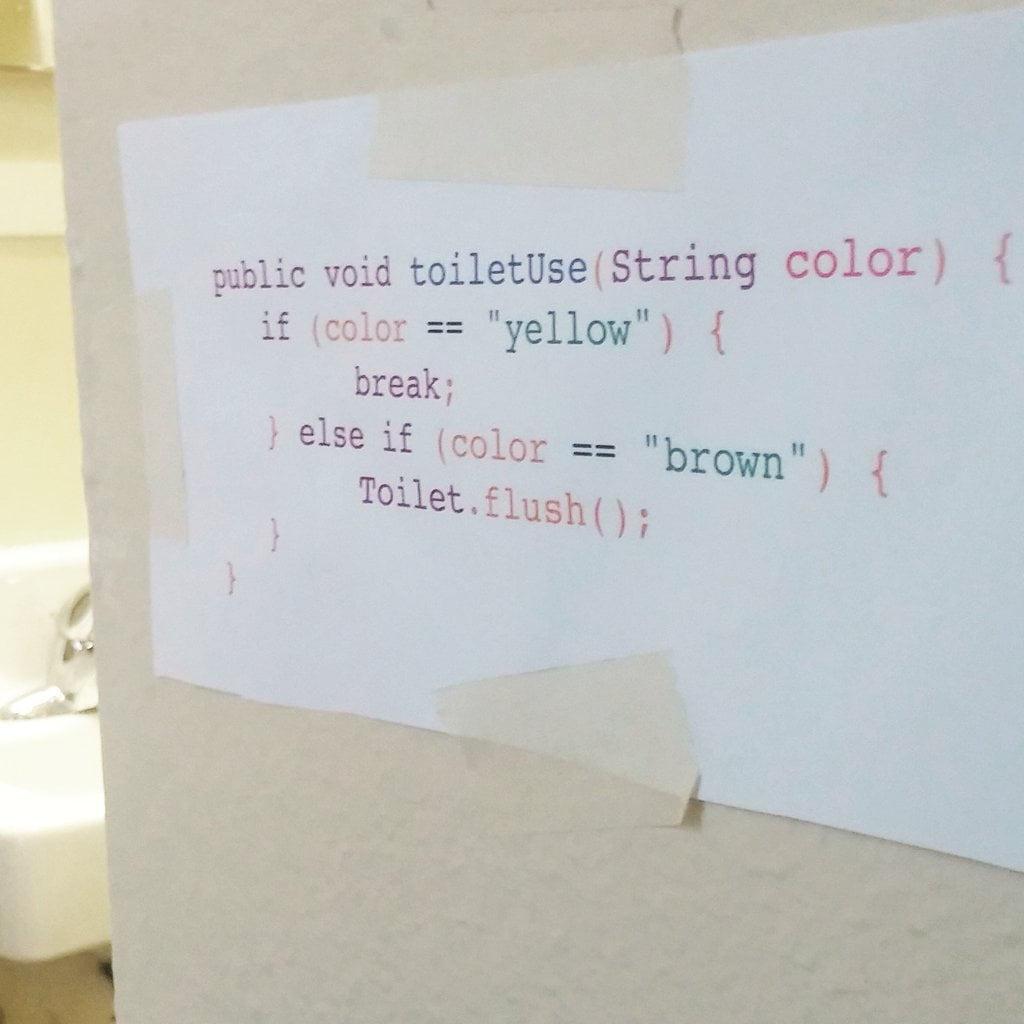
I’m currently living in a 17-person, sustainability focused community on Carleton College’s campus, called “Farm House.” When it comes to toilets, we tend to adhere to the classic environmentalist manta “if it’s yellow, let it mellow; if it’s brown, flush it down.”

Here is a java implementation of this central dogma, which I recently taped up in several bathrooms.

An image of a java version of "if it's yellow let it mellow, if it's brown flush it down."


The Myth of Conscientious Consumption

*Originally published in The Carletonian.*

The Viewpoint section of my school’s student Recycling symbolnewspaper posed the question “As a college student, what are your strategies for being a conscientious consumer without breaking the bank?”

This question implicitly relays the myth that ethical and sustainable living is prohibitively expensive. We are so inundated by ads for “eco-friendly” and “socially-responsible” products, we easily forget that simply not consuming is often the most powerful choice we can make.

Continue reading “The Myth of Conscientious Consumption” →